Twenty minutes from my home, a quiet Polish town hides stories most travel guides never mention: medieval weaponsmiths, uranium that helped build the Soviet bomb, and a sanatorium where doctors healed people with radioactivity.
Most visitors pass through Kowary on their way to Karpacz or the Karkonosze mountains. They see a small town of 10,000 people, a pretty market square, and forested peaks on the horizon. They don't stop.
That's a mistake. Because underneath the surface — literally, underground — Kowary holds one of the most unusual histories in all of Poland. The kind of history that makes you stop in the middle of a sentence and say: "Wait. That actually happened here?"
I live 20 minutes away. I've driven through hundreds of times. And I still find new things to be astonished by. This page is my attempt to share them with you.
The name gives it away, if you know Polish. Kowary comes from kowal — blacksmith. The German name, Schmiedeberg, says the same thing: Schmied (smith) + Berg (mountain). This wasn't a town that earned its name — it was born with it.
In 1148, a Walloon miner named Laurentius Angelus, sent by Polish Duke Bolesław IV the Curly, discovered iron ore deposits in the nearby Rudawy Janowickie hills. Within a decade, a mining settlement had formed. By the 14th century, it was famous for its blades, scythes, and metalwork.
The town's coat of arms — officially confirmed in 1513 by Bohemian King Vladislaus II — features a hammer, the universal symbol of the craft that built this place. A horse was added later. Together they've marked the city's identity for over five centuries.
In 1564, Polish King Sigismund II Augustus placed an order with Kowary's workshops: 200 musket barrels for his army. At the time, the town's 11 forges produced 3,000 centners of iron per year — making it one of the most important weapons manufacturing centers in all of Lower Silesia.
According to historical tradition, miners from Kowary fought in the Battle of Legnica — one of the largest battles in medieval Polish history, when a joint Polish-European force faced the Mongol invasion under Batu Khan.
In April 1947, everything in Kowary changed overnight. Iron mining stopped. Soviet officers arrived. The town was sealed off. And one of the most closely guarded secrets of the Cold War began.
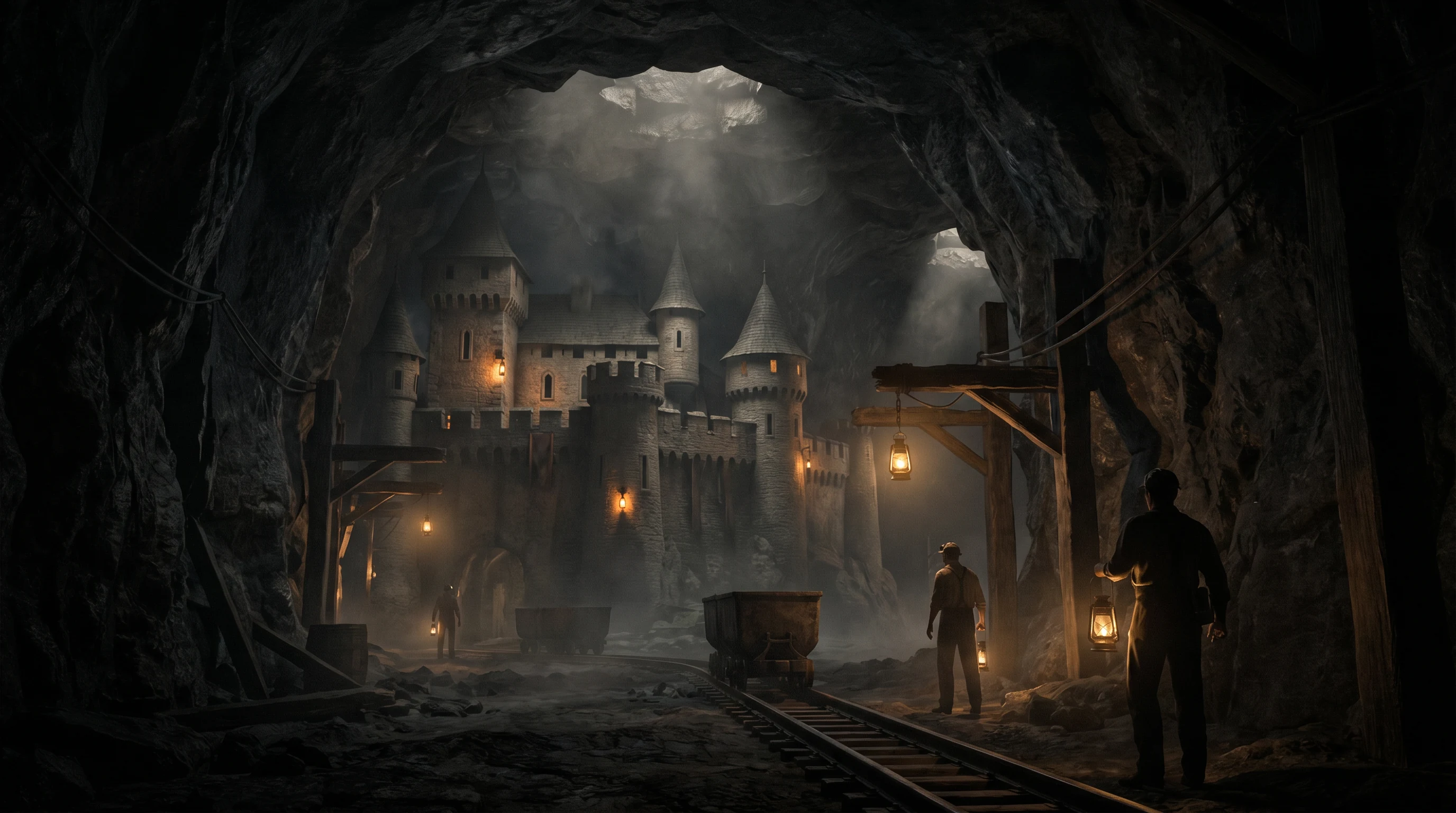
Soviet officers took control of the mines, renamed the operation "R-1 Industrial Plants" (Zakłady Przemysłowe R-1), and began uranium extraction under strict military secrecy. Polish workers were not told what they were mining. The area was surrounded by barbed wire and armed Soviet guards.
At its height, the R-1 operation employed 25,000–26,000 workers across all Polish uranium mines, with Kowary as the centerpiece. Every night, convoys of seven 4-ton trucks, guarded by Soviet soldiers, drove ore along the Kowary–Jelenia Góra road. More than 20 tunnels were bored into the mountain. Workers received no radiation protection and were given no explanation for the unusual ore they handled.
On August 29, 1949, the USSR tested its first atomic bomb — Joe-1 (RDS-1) — shocking the Western world. Some of the uranium that made it possible came from these tunnels in the Sudetes mountains of Poland. Historians estimate the ore extracted at Kowary was sufficient to produce 200 atomic bombs.
After Soviet troops withdrew in 1956, Poland continued mining at reduced scale until 1973. The tunnels were later used by Wrocław University of Technology for student geological practice. The radioactive tailings ponds remain an environmental concern to this day.
The Sztolnie Kowary underground tourist route opened in tunnel #9 of the former "Liczyrzepa" mine. Today visitors walk through multimedia exhibits, see original mining equipment, and breathe air with controlled radon concentration (~500 Bq/m³ — safe, and continuously monitored).
"The ore extracted here was sufficient to produce 200 atomic bombs."
— Historical estimate, Polish nuclear research archives
When the uranium mine was winding down, someone had a bold idea: what if the radioactivity itself was the medicine?
From 1974 to 1989, the tunnels of the "Podgórze" mine hosted one of only five radon therapy sanatoriums in the world. Patients — mostly suffering from arthritis, rheumatism, and respiratory conditions — would recline on steel deckchairs deep underground, breathing air rich in controlled doses of radon-222.
The science behind it is called radiation hormesis: the idea that very low doses of radiation can trigger beneficial biological responses — anti-inflammatory, pain-relieving, immune-boosting. It remains controversial, but the studies from Kowary showed measurable results.
National Geographic called it "one of the few places in the world where people were treated with radioactivity." The sanatorium closed after the political changes of 1989, but its story is preserved in the underground museum.
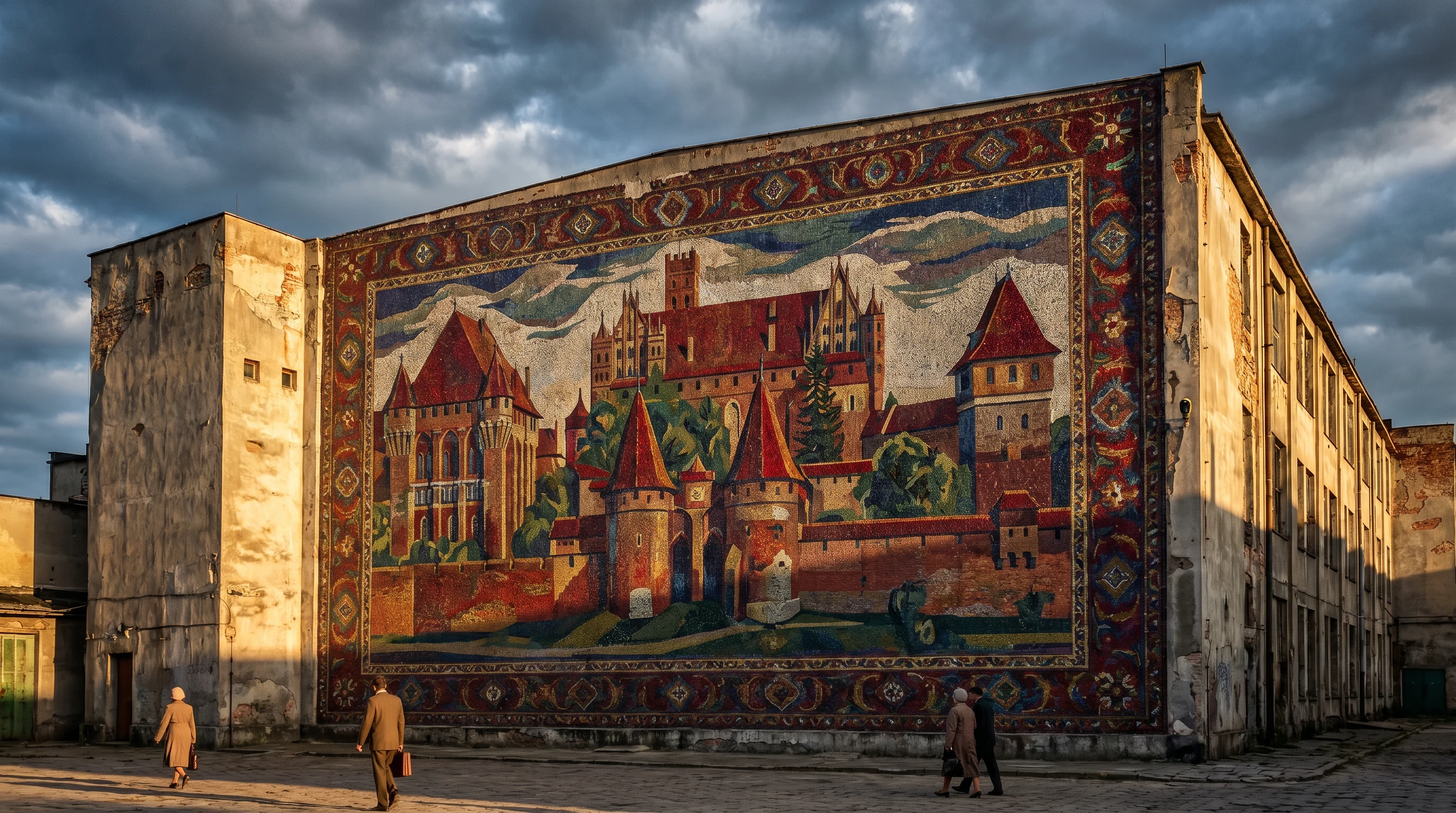
On one of Kowary's main streets, you'll notice a large, partially ruined building. Look carefully at its facade, and you'll see something extraordinary: a massive 9×8 meter mosaic made of 170,000 glass tiles in 18 colors.
This is what remains of the Kowary Carpet Factory — one of the major industrial enterprises of communist Poland. The word dywany means carpets in Polish, not sofas (a common mistake).
The mosaic was created in 1978 by the factory's female workers under the direction of artist Stanisława Lewkowicz. The tiles came from a glass factory in Wałbrzych. Designed to imitate the pattern of a Smyrna carpet — a nod to the factory's Turkish-inspired origins — it's now considered a significant example of Soviet-era public art.
The factory closed in 2009. The building is partially abandoned. But restoration of the mosaic is planned for 2025–2026, and it recently went viral on Reddit's r/sovietaesthetics.
Kowary sits on the DW366 road between Jelenia Góra and Karpacz. From Jelenia Góra: 20 minutes. From Wrocław: ~1.5 hours. From Prague: ~2.5 hours (beautiful drive through the mountains).
The main attraction. Book tickets in advance, especially on weekends. Open daily 10:00–17:00. Temperature inside: +8°C year-round — bring a jacket. Address: ul. Górnicza 13.
Open daily from 9:00. Combine with the mine for a half-day in Kowary. Perfect if you're traveling with children — or if you just love tiny castles.
Kowary is a gateway to Rudawski Park Krajobrazowy and the Karkonosze National Park. Trails lead through beech forests toward the ruins of Chojnik Castle — one of the finest hikes in Lower Silesia.
I live 20 minutes from Kowary. My family drives past it regularly on the way to our favorite mountain spring. We've stopped there dozens of times, and I still haven't run out of things to discover.
If you're visiting this part of Lower Silesia and want to include Kowary in your itinerary — or if you want a guide who actually knows these mountains personally — I'd love to show you around. A day trip from Jelenia Góra, Karpacz, or even Wrocław works perfectly.
Let's plan a trip together →Kowary is one chapter. The region has dozens more — castles, mines, ghost towns, border crossings, and places that only locals know about.